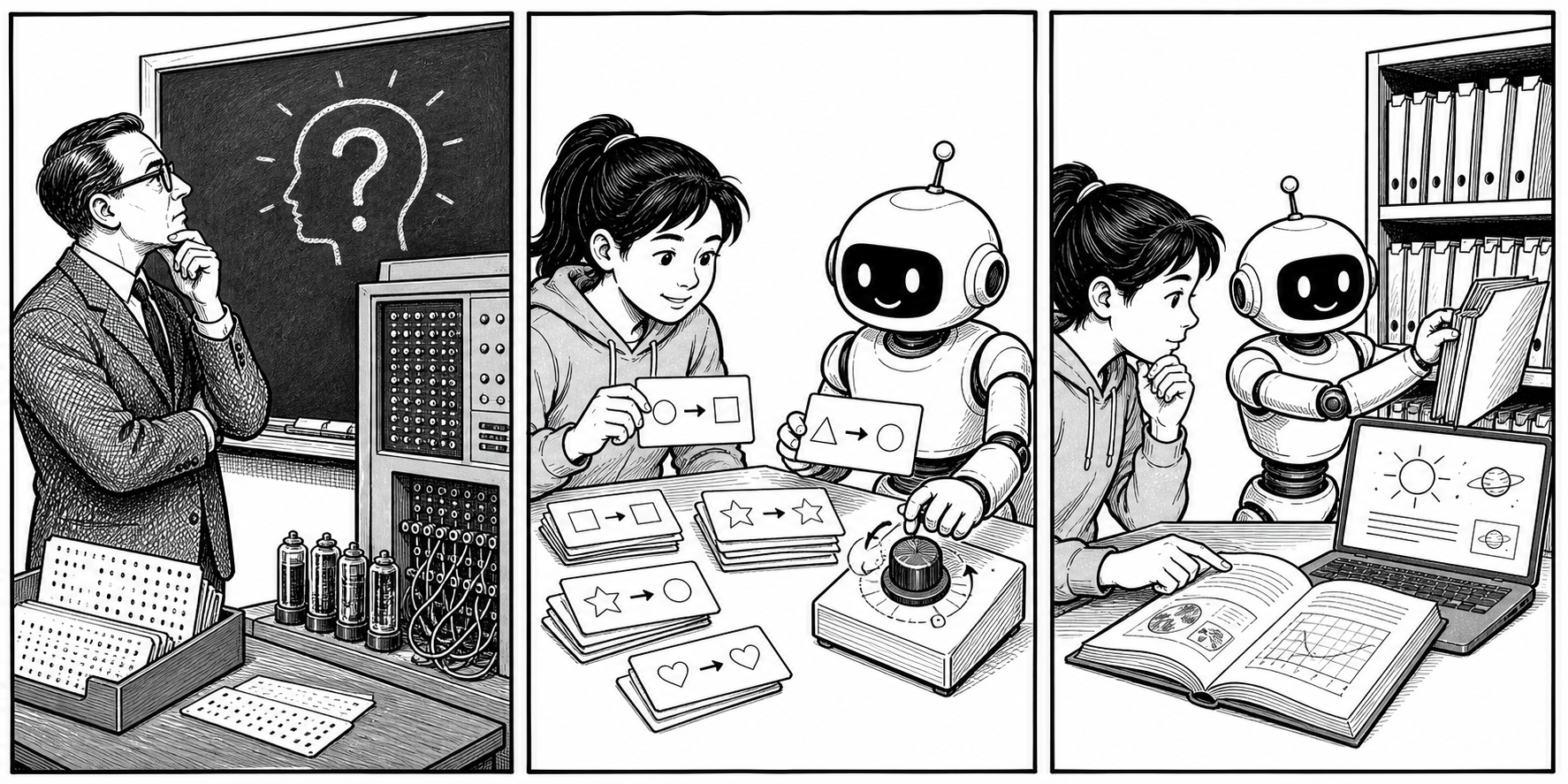
Artificial intelligence (AI) is the broad field of creating computer systems that perform tasks often associated with human intelligence, such as recognizing patterns, understanding language, or making predictions. Machine learning is a subset of AI: instead of receiving a rule for every situation, a model learns patterns from examples. A large language model (LLM) is a machine-learning model trained on large amounts of text to predict the next likely piece of language, called a token. Fine-tuning continues training with carefully chosen examples so a model follows a task, style, or format more reliably. RAG—retrieval-augmented generation—retrieves selected information at answer time, adds it as context, and asks the LLM to use it in an answer. RAG can still fail if its source is wrong, incomplete, or outdated; fluent language is not proof that a machine is correct, understands, or trustworthy.
Your 45-minute plan
0–5Launch: Where have you met AI today?
5–17Watch selected video chapters; capture three ideas
17–25Mini-lesson: AI, LLMs, fine-tuning, and RAG
25–40Map it: how fine-tuning and RAG make an LLM useful
40–45Explain it simply; exit ticket
Six stops in AI history
1950Alan Turing describes the imitation game as a way to discuss machine intelligence.
1955 → 19561955: McCarthy uses “AI” in a proposal. 1956: the Dartmouth workshop helps establish the field.
1966ELIZA shows how simple rules can create the appearance of conversation without understanding.
2012AlexNet makes a major leap in image recognition, helping spark deep-learning growth.
2017Transformers make it easier to train models on sequences, especially language, helping enable modern LLMs.
2022ChatGPT helps bring conversational LLMs to a huge public audience.
Make an LLM more useful
Fine-tuning: define the repeatable job, style, format, or behavior you want. Use a small set of clear, high-quality examples that demonstrate it. Fine-tuning continues training; it is not a magic button for adding every new fact.
RAG: draw the path question → retrieve approved information → add it as context → LLM generates → check the sources. RAG does not retrain the model, and it can fail if the retrieved source is wrong, incomplete, or outdated.
Choose the simplest tool: “use our friendly greeting every time” → prompt/template; “answer from this current club handbook” → RAG; “write a poem” → normal prompt; “invent a private fact” → neither. Explain one choice.